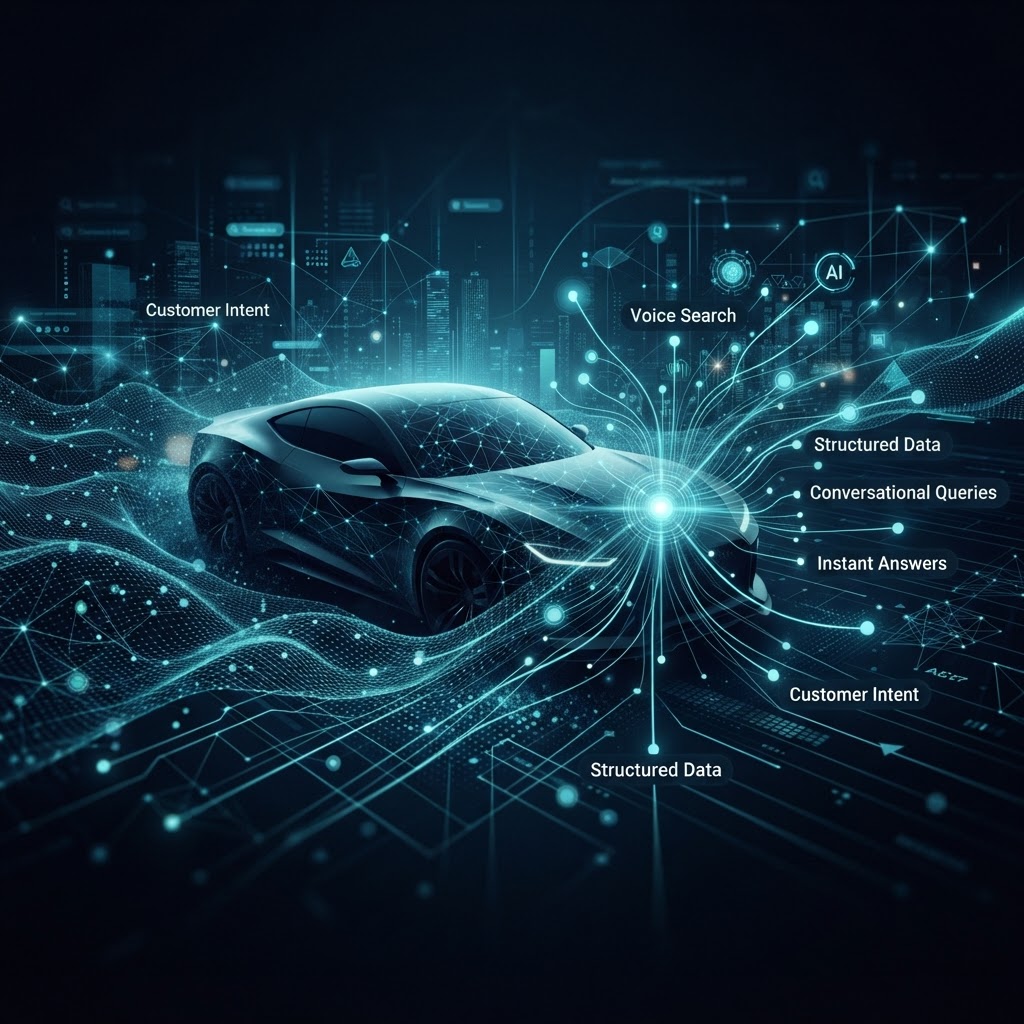
Beyond the Blue Link: Mastering Generative Engine Optimization for the Modern Dealership

Beyond the Blue Link: Mastering Generative Engine Optimization for the Modern Dealership
The traditional search funnel is breaking. For two decades, we have coached dealerships to obsess over the "ten blue links" on the first page of Google. We focused on ranking for high-intent keywords like "SUVs for sale near me" or "best lease deals." However, the emergence of Generative AI—specifically Google’s AI Overviews, ChatGPT, and Perplexity—has fundamentally altered the path to purchase.
Today, a shopper doesn't just get a list of websites; they get a synthesized answer. If your dealership isn't the source cited within that answer, you are effectively invisible to a growing segment of the market. At Car Media Group, we believe the next frontier of automotive digital marketing isn't just SEO; it is Generative Engine Optimization (GEO).
The Shift from Search Engines to Answer Engines
We are witnessing a transition from search engines that point to information to "answer engines" that provide it directly. When a consumer asks an AI assistant, "Which three-row SUV has the best safety rating and is currently in stock in Phoenix?" the AI doesn't just show a map. It crawls inventory feeds, safety reports, and local dealer content to generate a conversational response.
This shift means that "ranking #1" is no longer the ultimate goal. The new goal is to be the primary citation. In this new environment, the AI acts as a gatekeeper. To pass through, your dealership’s digital presence must be structured in a way that Large Language Models (LLMs) can not only crawl but also trust. We are moving away from keyword density and toward topical authority.
Building Topical Authority Through GEO
Generative engines prioritize authority and expertise. If your website only contains thin inventory descriptions and generic "About Us" pages, an AI will likely bypass you in favor of a competitor who provides deep, structured insights. We recommend moving beyond basic vehicle descriptions to create "content clusters" that answer complex buyer questions.
For example, instead of just listing a truck's towing capacity, we suggest creating content that compares that truck’s real-world performance against its top three competitors, citing specific trim levels available on your lot. This level of detail signals to AI models that your site is a definitive source of truth. When the AI needs to synthesize a comparison for a user, it will pull from the most comprehensive and structured data available. If that data is yours, your dealership earns the citation and the subsequent high-intent click.
Three Pillars of AI-Ready Content
To win in a GEO-dominated landscape, we advise our clients to focus on three specific tactical pillars. These are not just SEO best practices; they are requirements for being surfaced by generative models:
- Structured Data and Schema Markup: You must use advanced Schema (specifically AutoDealer, Vehicle, and FAQPage) to tell AI exactly what your data means. This ensures the AI understands that a number is a price, a string of text is a VIN, and a specific page is a service special.
- The BLUF Model (Bottom Line Up Front): AI models are designed to extract answers quickly. We recommend structuring your blog posts and research pages with a clear, concise answer in the first paragraph. This "snippet-ready" formatting makes it significantly easier for an AI to pull your content into an Overview.
- First-Party Data Integration: Your live inventory feed is your greatest asset. By ensuring your DMS (Dealer Management System) is perfectly synced with your website’s technical architecture, you allow AI engines to see real-time availability. An AI is much more likely to recommend a dealer that it knows for a fact has the vehicle in stock right now.
Measuring Success in a Zero-Click World
One of the biggest challenges we face with GEO is the "zero-click" phenomenon, where a user gets their answer from the AI and never actually visits your website. This requires a shift in how we measure performance. We can no longer rely solely on organic sessions as a KPI.
Instead, we must look at "Brand Mentions" and "Citation Share." Are AI engines mentioning your dealership by name when users ask about local inventory? Are you appearing in the "Sources" carousel of a Google AI Overview? We are also seeing a higher correlation between AI visibility and direct traffic; when an AI recommends you, the users who do click through are often much further down the funnel and ready to transact.
At Car Media Group, we view this not as a threat to SEO, but as an evolution. The dealerships that embrace GEO today will be the ones that own the conversation tomorrow. The blue links aren't gone yet, but the answers are where the sales are happening.
This article was independently written by the Car Media Group team. Topic inspired by "Cars Commerce".
Comments (0)
Be the first to share your thoughts.